
This post is about using mirrors to capture reflections on the street. When I'm walking, I'm constantly looking for reflections in car windows, the hoods of parked cars, shop windows, puddles and, once in a while, an actual mirror. Mirrors are the least common of the group, so when I find one, I stop and stay with it for a while.
What I Look For
I'm looking for color and an interesting subject. The mirror itself is rarely the picture. What matters is what shows up inside it and what sits around it.
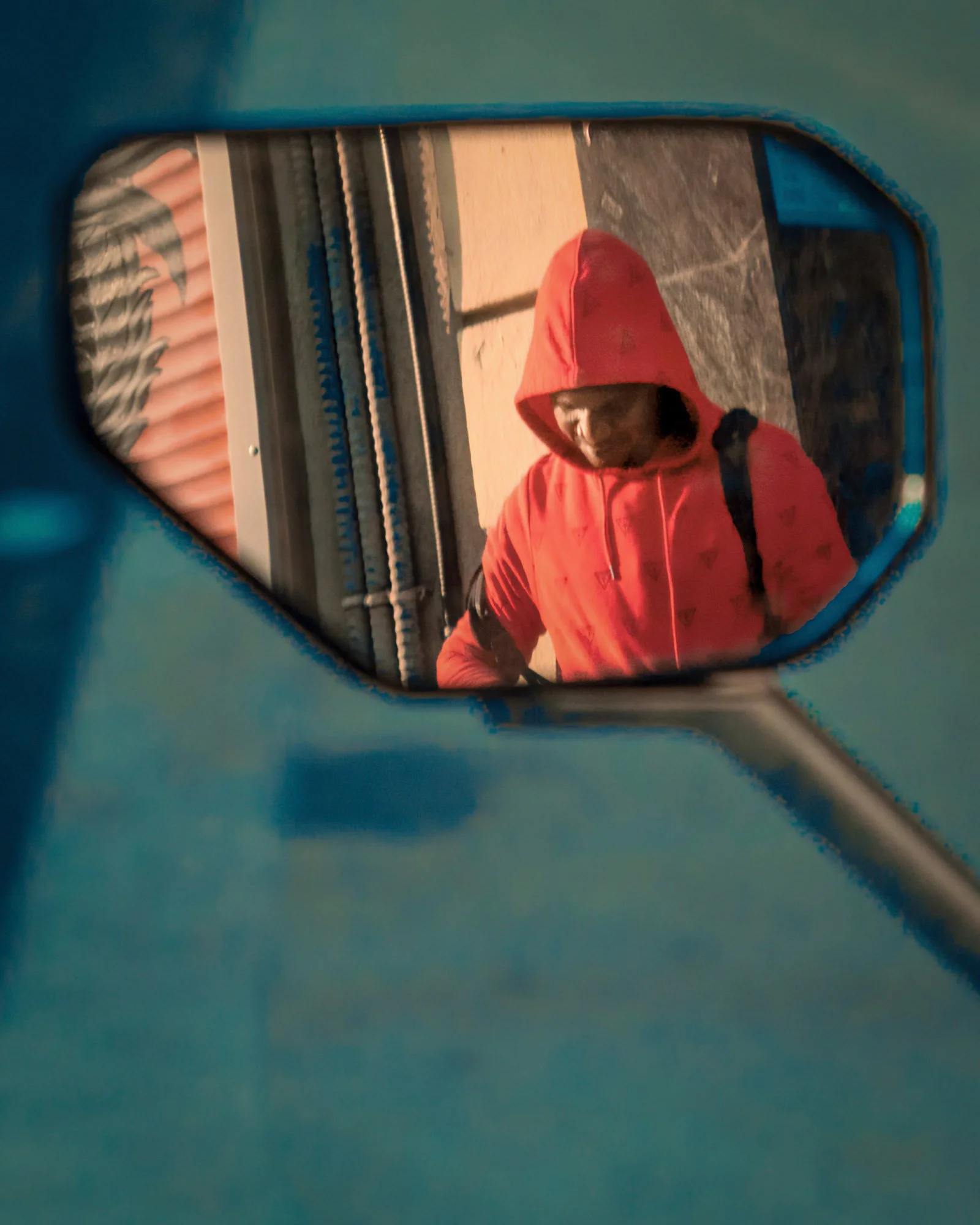
In Kensington Market in Toronto, it was the red hoodie that stopped me. The teal around the mirror makes the red stand out even more.
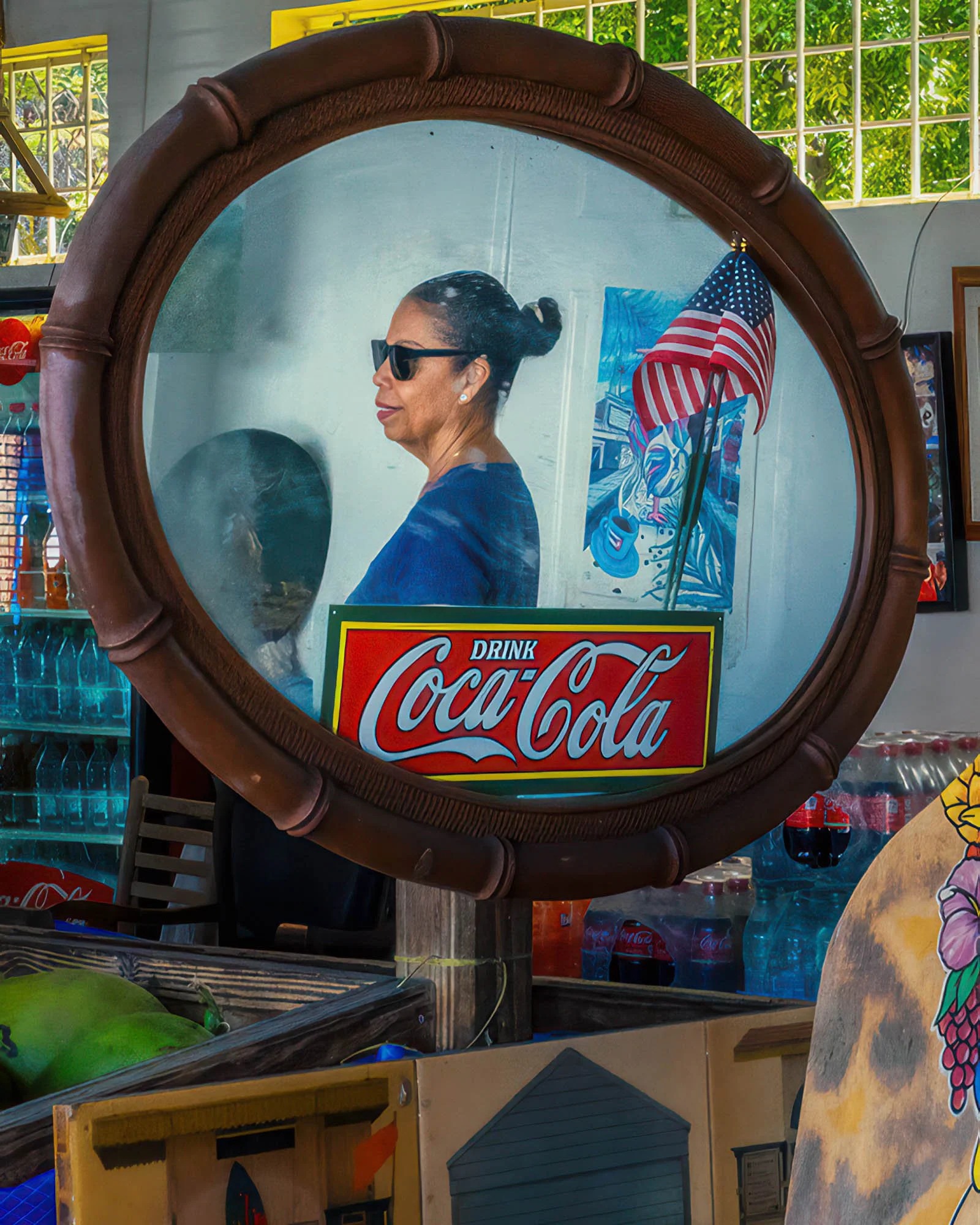
A mirror also gives you a frame inside the frame, a built-in border around the subject. The shape of that border changes the picture. A round wood frame reads differently from a plain rectangle or the oval of a car's side mirror. Here, in a shop in Little Havana, the woman in sunglasses and the flag behind her sit inside the circle, and the Coca-Cola sign overlapping the bottom of the frame ties the reflection back to the shop front.
Where to Find Mirrors
Freestanding mirrors don't turn up often, so it helps to know where they tend to be.
Car side mirrors. Every parked car has one, which makes them the most reliable mirror on any street. They're convex, so they take in a wider scene than a flat mirror and bend the edges into a curve.
Shops with stock outside. Antique and junk shops sometimes lean mirrors against the wall or set them out on the sidewalk with the rest of their goods.
Barbershops. The mirrors run the length of the wall, and you can often work them from the doorway or through the front window.
Curbside furniture. A mirror left out on bulk trash day sits at street level, and it won't be there long.
Sunglasses displays. The lenses on a rack outside a shop work like small mirrors, and the tinted ones add their own color to the reflection.
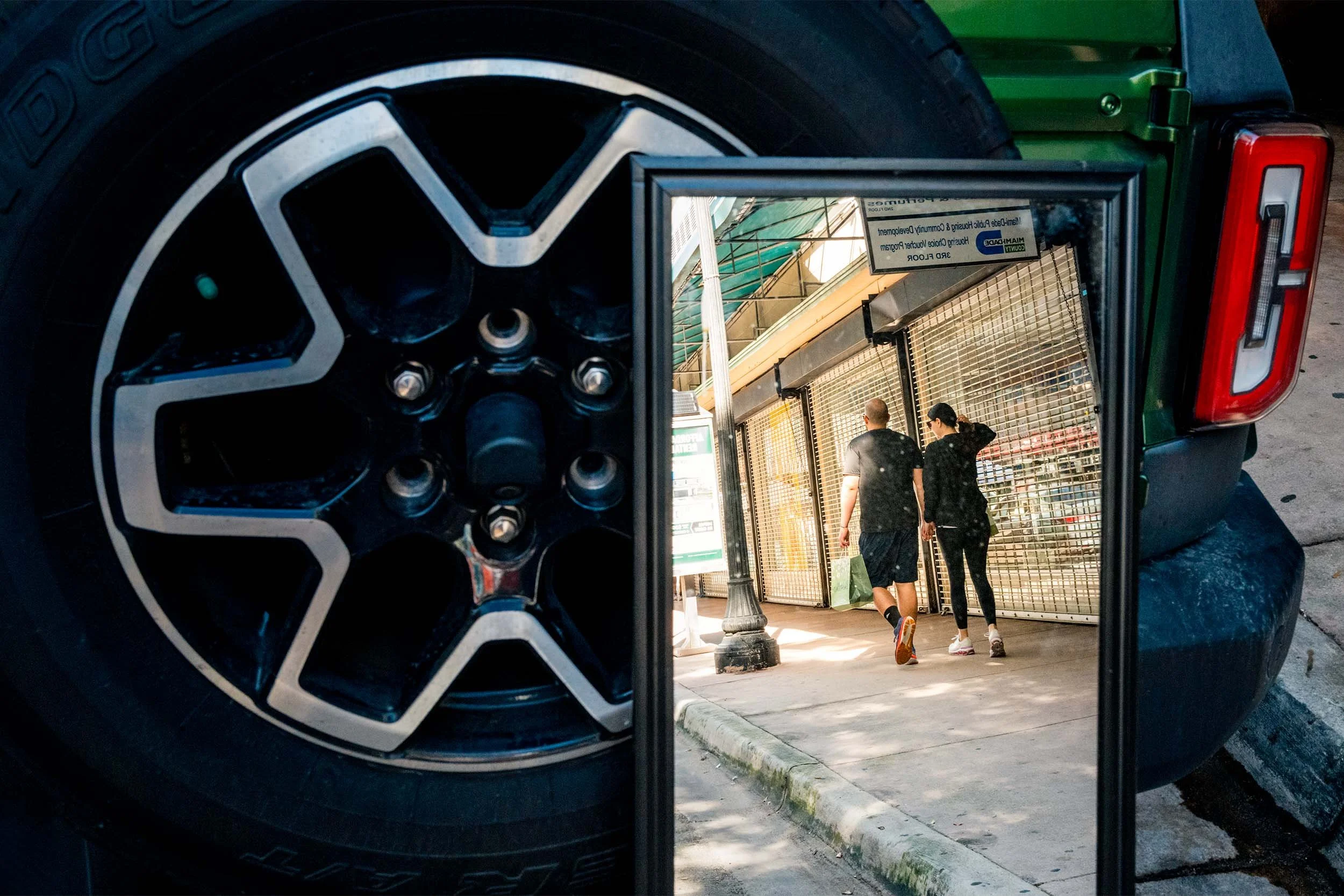
This mirror was leaning against the wheel of a parked SUV in downtown Miami. The tire fills half the frame, and the reflection shows two people walking down the sidewalk past rolled-down security grates. Neither half would hold up as a photo on its own.
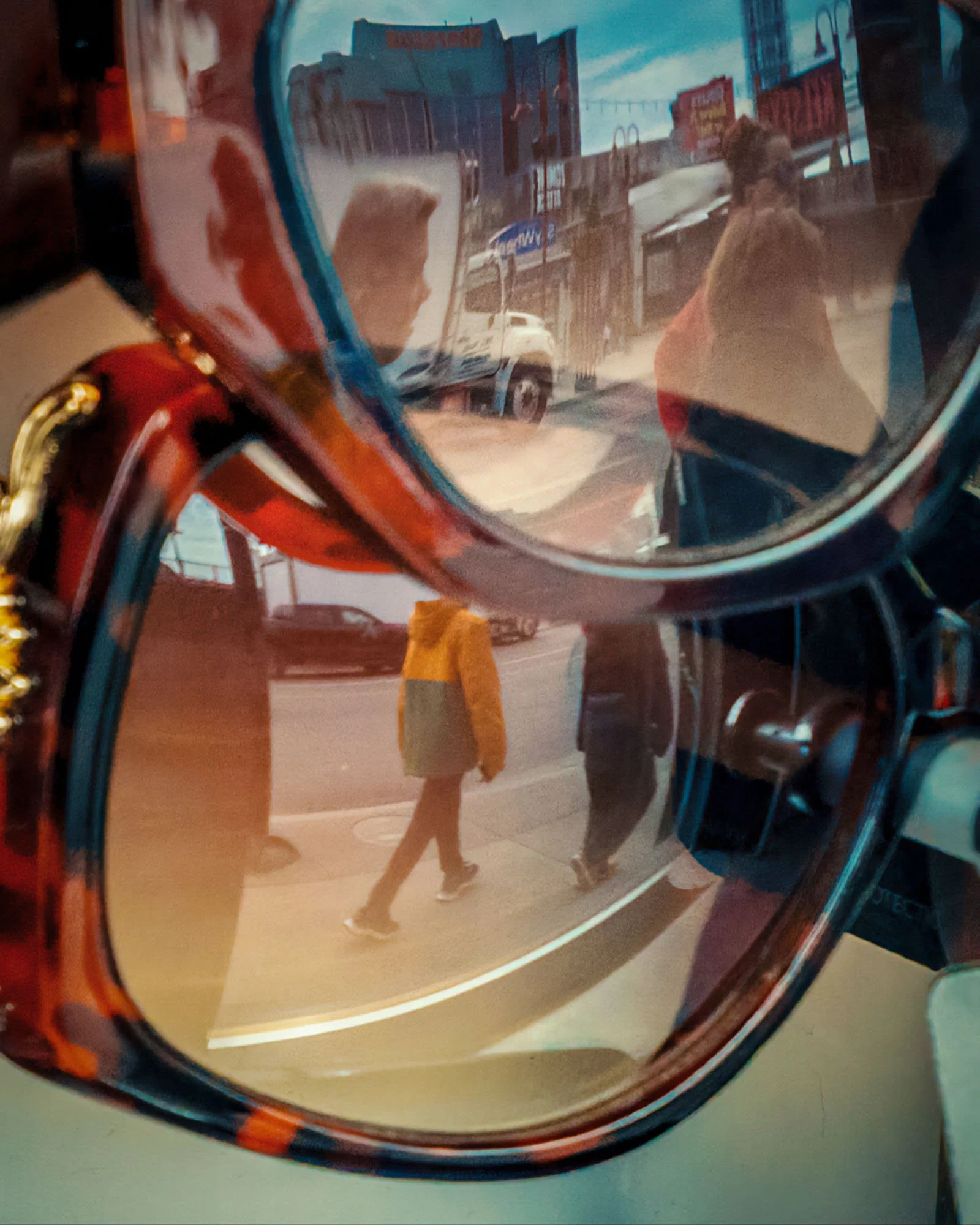
On this rack in downtown Vancouver, the same walker shows up in two lenses at once, warm in one and blue in the other, both times mid-stride.
Waiting for Someone to Walk In
Finding the mirror is the easy part. Most of the time I compose the shot, then wait for someone to walk into the reflection. That can take a while.
If the subject is moving, I'll often switch to burst mode. I'm after the exact moment in the stride when the legs separate into an open V, so the figure reads as walking, not standing. One frame in the burst usually has it.
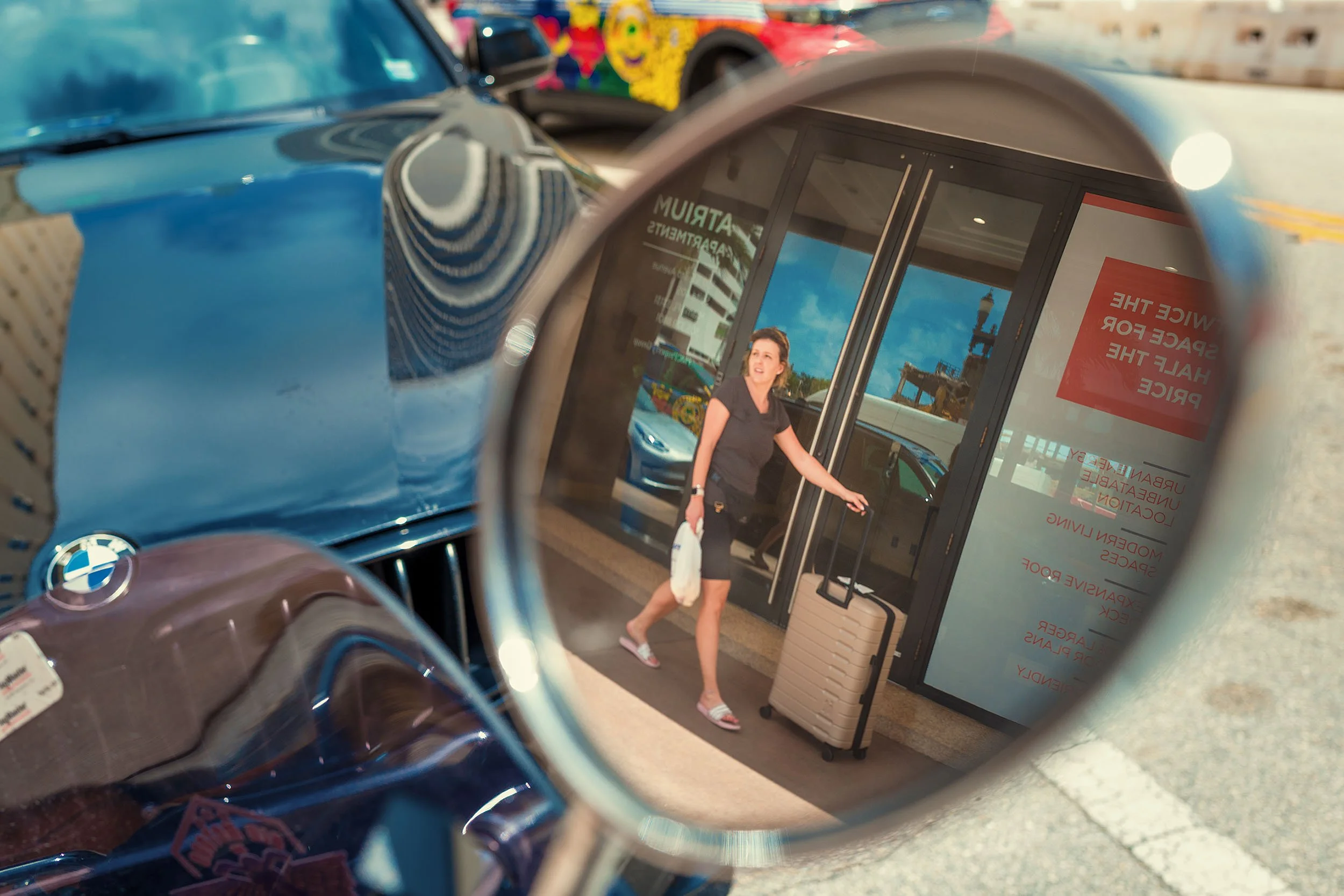
The BMW side mirror, on a street in downtown Miami, is a good example. The woman pulling her suitcase out of the building is mid-stride, and the convex glass bends the doorway around her.
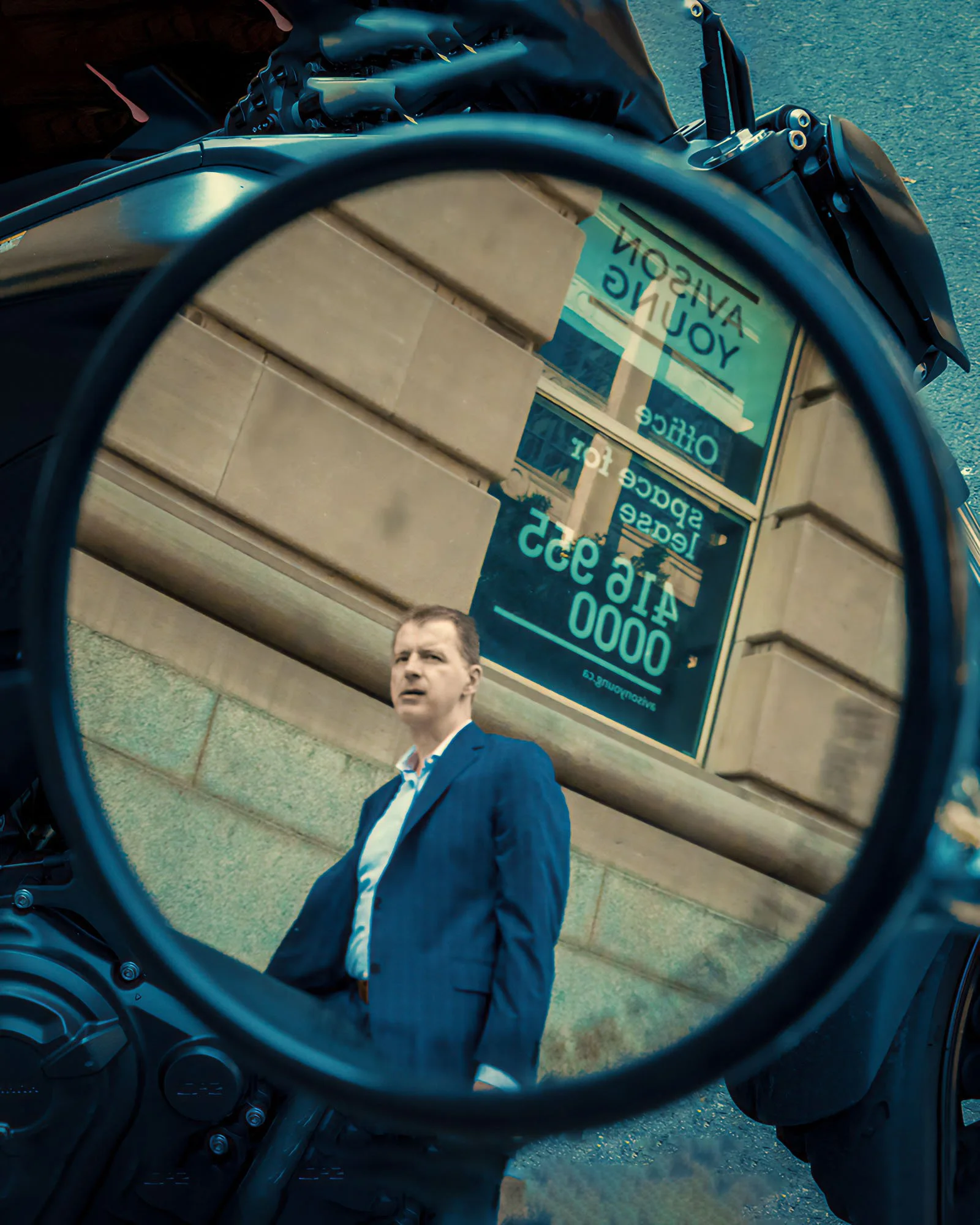
Reversed text is something to notice before you press the shutter. In this motorcycle mirror in downtown Toronto, the "Office space for lease" sign behind the man reads backwards, which tells you right away you're looking at a reflection. You can use it on purpose, the way I did here, or crop it out.
Getting the Reflection Sharp
Focus on the reflection. The reflected subject sits at the distance to the mirror plus the distance from the mirror to the subject, so autofocus will often lock onto the mirror's frame or the dust on the glass. I use manual focus on the street a lot anyway, and this is where it matters most.
Decide what's sharp. Stop down if you want both the mirror frame and the reflection crisp. Open up if you'd rather let the frame go soft and keep the attention on the subject.
Use exposure compensation. Reflections come out darker than the scene around them. A mirror loses a little light and a window loses a lot, so when the reflection looks too dark, I adjust with exposure compensation.
Check the surface. Dust and smudges show up quickly in hard sun or at small apertures, and they're much harder to clean up in post than a spot on a wall.
Keep yourself out. Stand at an angle to the mirror so your own reflection isn't in the frame. Step left or right until you disappear.
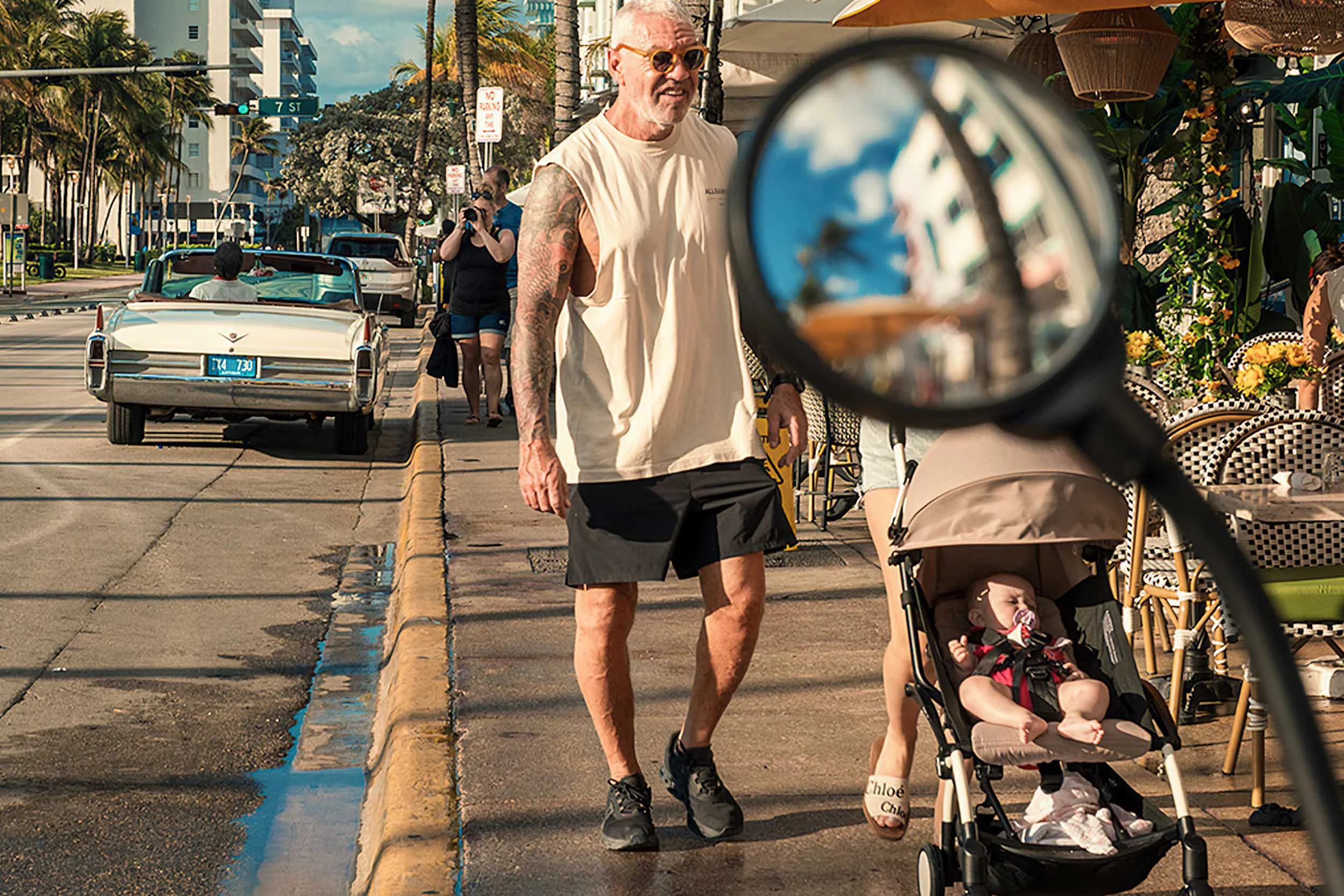
On Ocean Drive in South Beach, I went the other way. The mirror sits soft in the foreground, and the sidewalk behind it is sharp, with a man walking beside a stroller and a white convertible out on the street. The mirror only shows sky and a building, so here it's part of the frame, not the subject.
Candid by Default
Mirrors are a great way to get candid shots, because the subject is almost always unaware of you. Technically, if you can see someone in a mirror, they can see you too. In practice, people walking down the street don't look at mirrors, so they never notice.
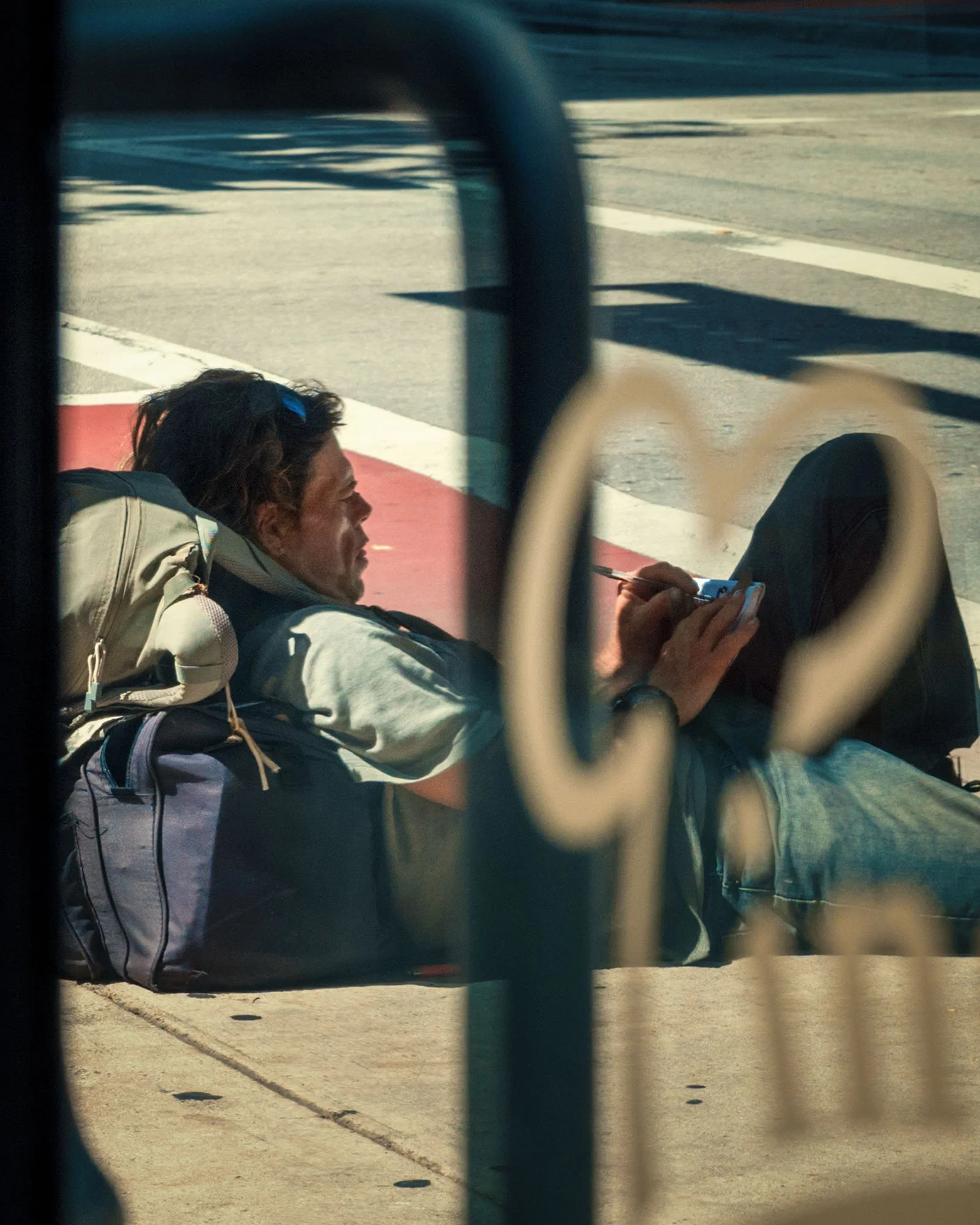
This was the most complicated shot in the group. The mirror was inside a store in downtown Miami, and I had to face it straight on to take the picture. That put the man stretched out on the sidewalk behind me, so I was composing on someone I could only see in the mirror. He was busy with his phone and had no reason to look up.
Facing a mirror straight on is also the hardest way to keep yourself out of the reflection, so I had to contort my body to get myself out of the shot.
On your next walk, glance at the side mirror of every parked car you pass. Most will show you nothing worth shooting. Every so often one will frame someone walking straight toward it, and if you stop and wait, you'll be in position when they get there.